All About the Poison Dart Frog: Weird and Wonderful Facts
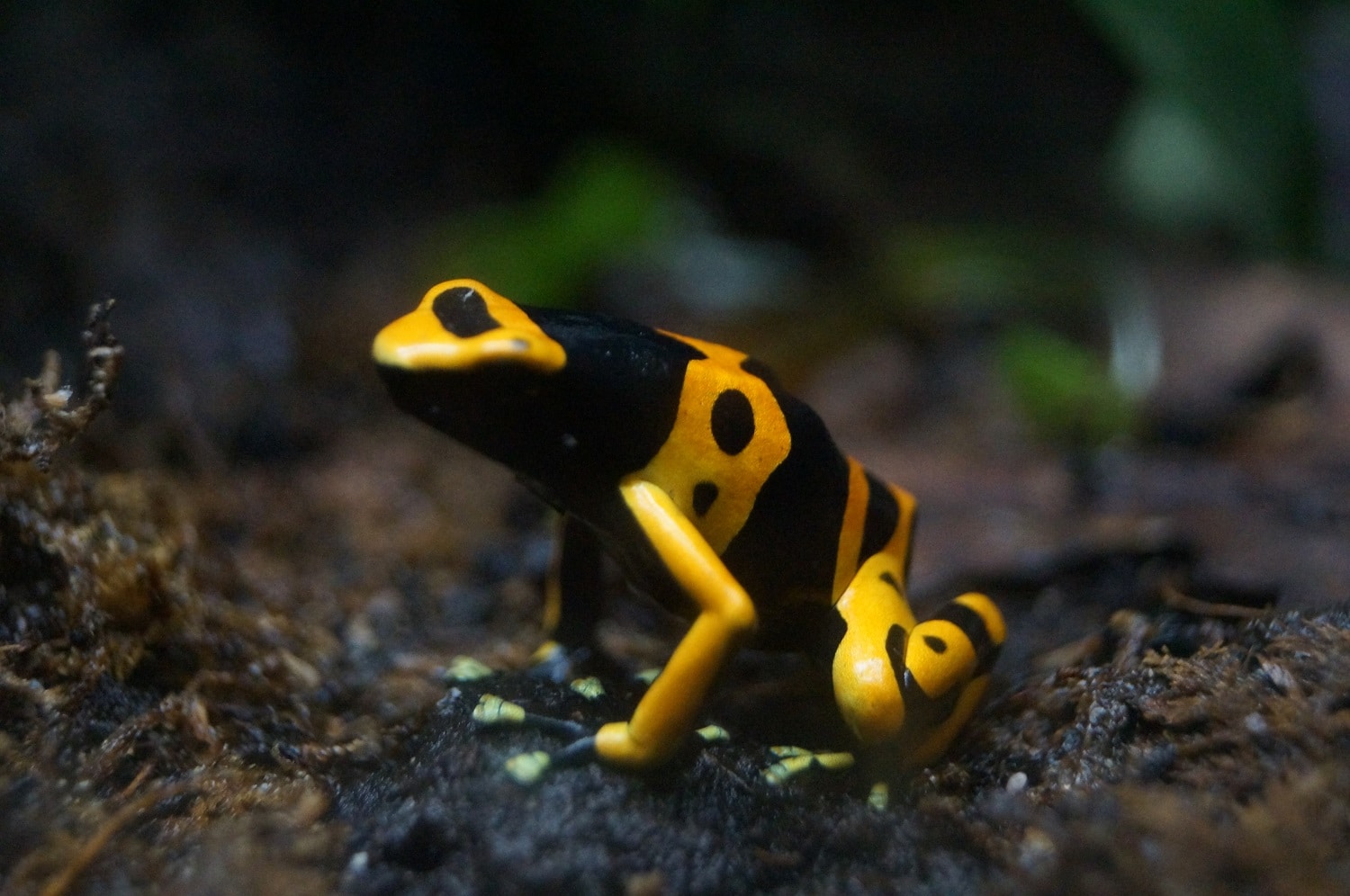
Poison dart frogs are undoubtedly beautiful creatures, with exotic colours and patterns who deserve your respect. Their incredible colours are more than just a fashion show; they’re a physical representation of their deadly nature!
In this post, we’re showcasing the poison dart frog in all its weirdness and beauty. Filling you in on everything from the different types of poison dart frogs, fun facts about them and the types of poison dart frogs we’re lucky enough to have at Blue Planet Aquarium.

What are poison dart frogs?
Poison dart frogs, a common name for animals in the Dendrobatidae family, are a group of amphibians. Unlike many other amphibians, poison dart frogs are diurnal, meaning they’re most active in the daytime – just like humans. This is quite rare for frogs, as most species are nocturnal.
Poison dart frogs are primarily terrestrial animals, meaning that they spend most of their time on the forest floor, where they hunt for ants, termites and mites. They use their sticky, retractable tongue to catch their prey.
What does a poison dart frog look like?
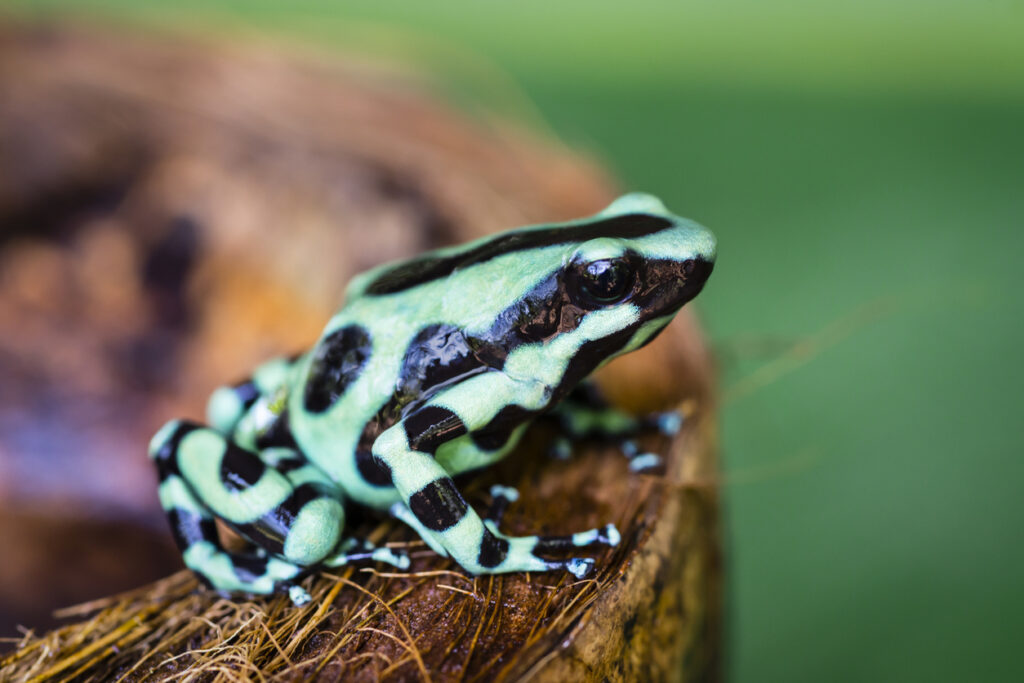
If you spotted a poison dart frog in the wild, you’re unlikely to forget it because they are simply beautiful animals. They’re brightly coloured frogs, typically only growing between 2.5 cm and 6 cm. Despite their small size, poison dart frogs have adorably large eyes for their size, which adds to their beauty.
They have four legs, each with four sticky fingers, which help them to climb and grip leaves, roots, and rocks as they hop around the forest.
Why are poison dart frogs brightly coloured?
You might be wondering why an animal so small would want to be so well-seen in the rainforest, and it’s a great question with an interesting answer.
Poison dart frogs are aposematic animals, which means that their colouring is a warning to predators to say, “don’t eat me, I’m poisonous”. You’ll also see this type of colouration on venomous snakes.
Where do poison dart frogs live?
Poison dart frogs live in the tropical rainforests of Central and South America. The humid climate means they can live away from permanent bodies of water.
While the rainforest is their preferred habitat, poison dart frogs live in many types of tropical environments. This includes marshes, shrubland, swamps, savanna grasslands, and farmland.
Despite severe habitat destruction, true poison dart frogs remain endemic to the tropical and subtropical regions of the Americas.
What do poison dart frogs eat?
Poison dart frogs are carnivores, surviving on a diet of small insects, including things like fruit flies, termites, ants, young crickets, and some smaller species of beetles.
An interesting theory some scientists have is that poison dart frogs became toxic because of their diet. Through a long period of evolution, the frogs became toxic.
This has proven to be the case since poison dart frogs have been brought into captivity, because captive poison dart frogs lose their toxicity due to a different diet of non-poisonous insects.
How poisonous are poison dart frogs?
Not all poison dart frogs are poisonous, but those that are poisonous tend to be highly toxic; they’re not even safe to handle.
To put this toxicity into perspective, the most poisonous of the lot is the golden poison frog (Phyllobates terribilis), which is thought to have enough toxin in its skin to kill 20,000 mice or 20 fully-grown people.
Poison dart frogs get their name from Native Americans, who would use their toxic secretions to deadly effect by applying them to blow darts, used for hunting.
To hammer home their deadly nature, the herpetologist who discovered the Golden poison frog gave them the name Phyllobates terribilis.
Are poison dart frogs endangered?
Sadly, many poison dart frogs have appeared on the endangered list for a number of years, as deforestation and human infrastructure projects continue to encroach on their natural habitat.
Over the past three decades, poison dart frogs have slipped further down the IUCN’s conservation chart.
Habitat loss isn’t the only thing which threatens poison dart frog numbers. Chytridiomycosis, a bacterial disease found in amphibians, kills thousands of animals each year. Rising temperatures make it easier for bacteria to incubate in tropical environments. Putting species like poison dart frogs right in the firing line.
See poison dart frogs at Blue Planet Aquarium
With their amazing displays of colour, poison dart frogs put on quite the show for such small animals. That’s why a visit to the Frog Zone at Blue Planet Aquarium is a must for a close (but not too close!) encounter with these wonderful creatures.
Our Frog Zone is home to three incredible species of poison dart frog.
Golden poison frog
The golden poison frog (Phyllobates terribilis) is beautiful but lives up to its fearsome name. As its name suggests, this species has a brilliant, vibrant golden-yellow colouration, although some individuals may appear more orange or pale green.
Despite its tiny size, typically reaching just over 5 cm in length, it’s one of the largest species of poison dart frog. It is crucial to note that the golden poison frog is considered the most toxic vertebrate on the planet, possessing enough poison to be lethal to several humans. It is native to the humid rainforests along the Pacific coast of Colombia, where it spends its time on the forest floor among the leaf litter, near small streams or rivers. It’s currently an endangered species.

Anthony’s poison dart frog
Comparing Anthony’s poison dart frog (Epipedobates anthonyi) to the golden poison frog shows just how much colour variation there is within the family.
This frog typically only grows between 2 and 3 cm and has a beautiful pattern of dark brown or black, with two bright, narrow, cream or greenish-yellow stripes running down its back. While not as potent as the golden poison frog, this species produces an alkaloid toxin in its skin, which is strong enough to deter predators and can cause serious illness if handled. You would find this delightful amphibian predominantly in the humid, tropical forests and foothills of Ecuador and Peru, usually in areas close to streams. Anthony’s Poison Dart Frog is currently listed as Near Threatened, with conservation efforts ongoing.
For a fun and educational way to see some of the world’s most beautiful amphibians and marine animals, book your tickets to Blue Planet Aquarium today.


