How Do Snakes Move?
A lack of legs has never stopped snakes from being agile creatures capable of striking movements. Thanks to an impressive list of adaptations, they don’t need legs, arms or wings to help them move from A to B. They also make light work of hunting for food and hiding from predators, even without the usual appendages.
In this guide, we’ll be exploring the different methods of snake movement, as well as diving into the anatomical features that make it happen.
Snake movement studied in detail
Snakes may not have legs, but their strong, flexible spines, scaly skin and intense muscle power, with up to 400 curved rib bones, more than make up for the loss. Not only can they keep their grip on the ground because of these features, but some species can even climb, burrow and swim.
There are four main types of movement for snakes, including lateral, sidewinding, concertina and rectilinear. Snakes will use different methods depending on factors like habitat conditions, species size and hunting habits.
Below, you can learn more about each method, including how and why each one works.
Lateral
Also known as serpentine movement, this is the motion you probably associate most with snakes. They move side-by-side, creating an ‘S’ with their long bodies as they navigate relatively flat land and sometimes water. During this movement, a snake will shift its weight to create curves and use its scales for grip on the terrain.
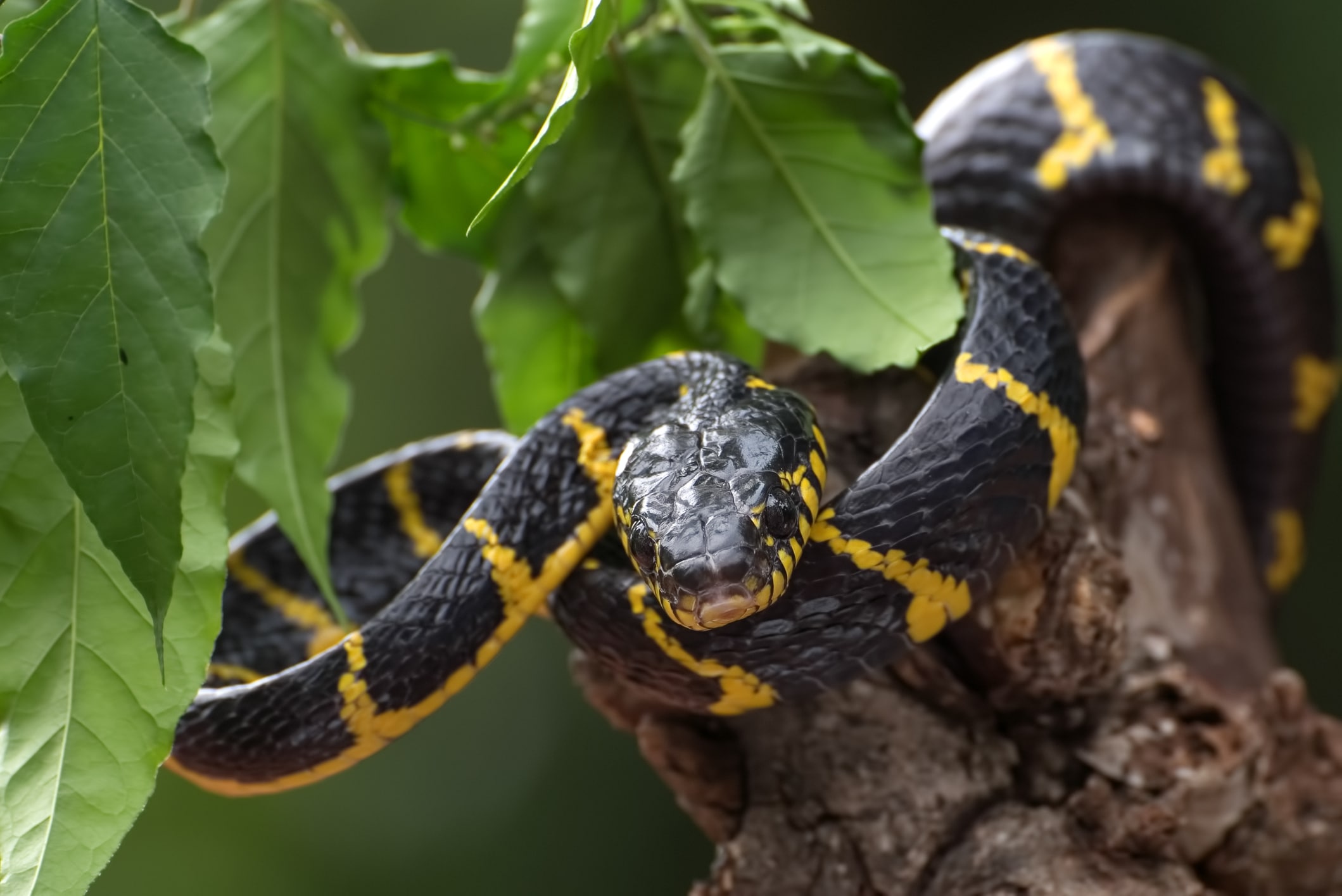
Mangrove snakes (Boiga dendrophilia) often use this method of motion to slither across tree branches and swim through brackish waters.

Sidewinding
Sidewinding is like lateral motion in snakes because they twist their bodies into curves for this type too.
The difference is that, to achieve a sideways shifting motion, snakes will plant their heads and tails against the surface while using their muscles to thrust the non-contact parts of their bellies upwards.
Desert snakes, such as the sidewinder rattlesnake (Crotalus cerastes), use a sidewinding motion to navigate the loose ground in deserts and grip it effectively.
Concertina
This stop-and-go technique is perfect for vertical movement, such as climbing trees or poles. A snake stretches forwards or upwards and grips with the front of its body, then bunches the middle of its body into a tight loop to anchor itself forward. It repeats this movement until it reaches its destination.
Concertina movement allows snakes to reach up and catch prey such as birds in the trees.
Rectilinear
With rectilinear movement, a snake moves slowly in a straight line without bending its body. While this would be impossible for many other creatures, the strong belly muscles and backwards-facing and overlapping scales on a snake’s underside make the impossible possible.
Snakes will grip the ground repeatedly and propel themselves forward, which is handy for traversing tight spaces where lateral or sidewinding movements would be tricky.

How fast can snakes move?
Most snake species move between 2mph and 10mph, with more being on the slower end of the scale. But while they might be mostly slow movers, their strike is lightning fast.
Black mamba snakes (Dendroaspis polylepis) are widely recognised as the fastest land snake at 9-11mph. This African snake will speed away at any sign of danger, preferring to flee rather than have a confrontation with another creature.
Another fast snake is the sidewinder rattlesnake (Crotalus cerastes), capable of moving up to 11-12mph (18kmh). The sidewinder rattlesnake is an ambush predator, so it uses its quick speeds to bury itself and wait for prey to walk by.
Meanwhile, the rosy boa (Lichanura trivirgata) is considered to be the slowest snake species, travelling at an average of around 0.25-0.5mph. They live in the Mojave Desert and will hide amongst rocks, tucking their heads in and curling up in a ball with their tails sticking out when they sense danger.
Can snakes move backwards?
Snakes are much more efficient at moving forwards than backwards. This is because the scales on their bellies point forwards, helping them grip the surface as they travel ahead of them.
The scales can create enough friction to move backwards if a snake needs to, but the movement is much slower.
See our snakes at Blue Planet Aquarium
Ready to see some snakes in action? Our Venom exhibit at Blue Planet Aquarium houses the mangrove snake, a striking yellow-and-black-bodied predator.
This venomous snake species uses lateral and concertina movement to climb trees and traverse uneven ground in the mangroves and rainforests of South East Asia where the species is a native. But since it only rears its head at night to hunt for small animals, you’d be unlikely to spot one in its natural habitat, which is why it’s such a treat to have them here.
Book your tickets today to see our snakes and many other marine creatures in action at Blue Planet Aquarium.


