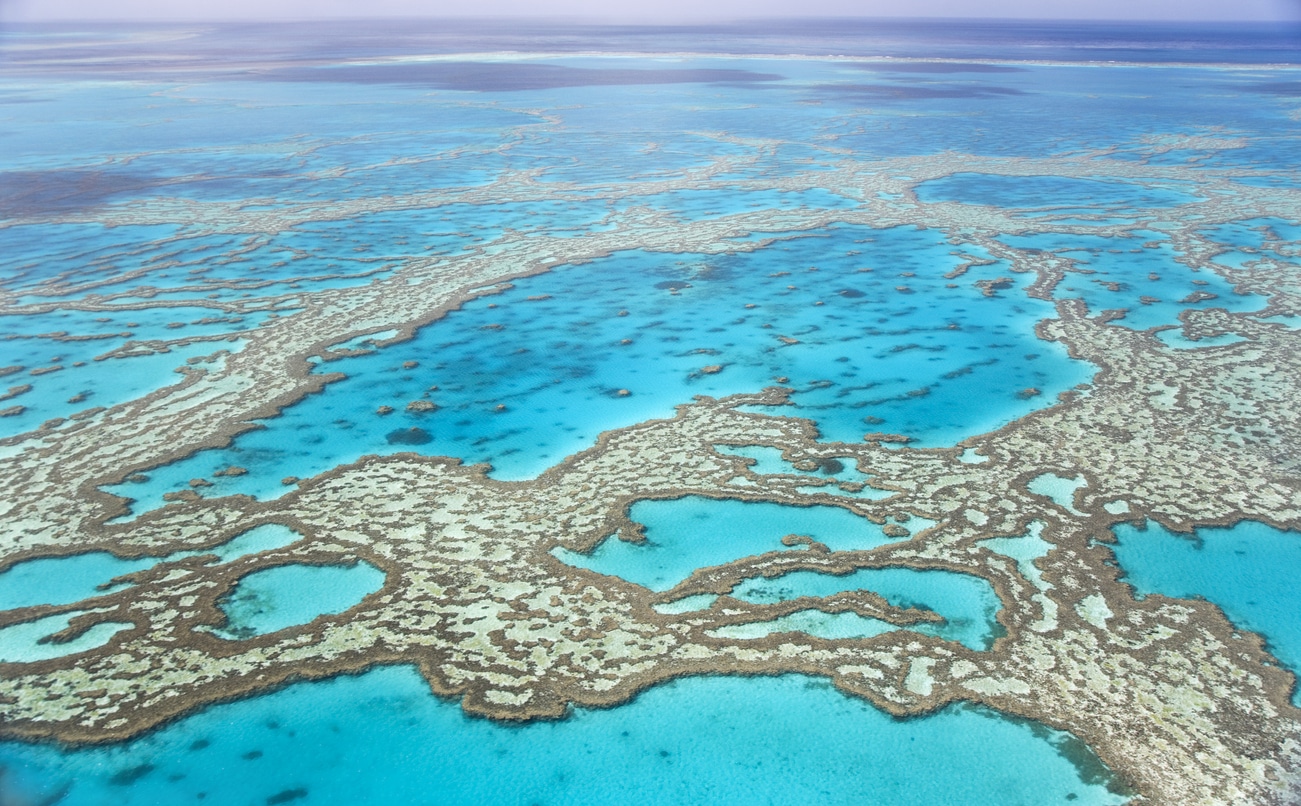
Exploring the World’s Greatest Coral Reefs
Coral reefs are filled with incredible biodiversity, sustaining life across the globe. While you might have heard of the Great Barrier Reef, it’s far from the only coral reef, even if it is the largest.
They are an incredible part of our world, serving as complex habitats that provide shelter, food and breeding grounds for over 25% of marine species. In this blog, we’ll take a look at coral reefs in more detail to understand more about them from around the world.
What is a Coral Reef and Why are they Important?
A coral reef is the collective structure of the hard corals that shape this type of ecosystem. Coral reefs are actually built by animals called coral polyps. They’re tiny, soft-bodied marine animals related to jellyfish and anemones that use calcium carbonate to secure themselves to rocks or the seafloor and, in turn, build coral reefs.
Coral reefs are crucial to an incredible number of marine species because they provide a multi-layered environment that offers great opportunities for animals to feed, reproduce, and escape predators.
The coral reefs offer an environment like no other, which is why it’s so important that they remain healthy.
Where are Coral Reefs Found?
Coral reefs are primarily found in tropical and subtropical waters, favouring shallow, clear water as they rely on sunlight for photosynthesis. However, you will also find cold water coral reefs that grow in darker, deeper and colder water.
While coral reefs only make up less than 1% of the Earth’s surface, you will find them in more than 100 countries. However, over 90% of tropical reefs are in the Indo-Pacific region because of its very salty, warm water that provides the perfect environment for tropical coral reefs to be built.

World’s Most Impressive Coral Reefs
Coral reefs are beautiful, colourful, and vibrant hubs of marine life. There are, however, a few standout examples across the globe that will surprise you with their beauty, age, or sheer size.
The Great Barrier Reef
The Great Barrier Reef sits off the coast of Australia and is so large that it can actually be seen from outer space. While its foundations are ancient, the living reef we explore today is about 8,000 years old and stretches for over 2,300 kilometres. The Great Barrier Reef is home to a wide range of animals, including the dugong (Dugong dugon) and the massive whale shark (Rhincodon typus). This UNESCO World Heritage site is famous for its vibrant colours and shallow, sun-drenched waters that make it a favourite for tourists and marine biologists.
Red Sea Coral Reef
The Red Sea Coral Reef runs along the coastlines of countries like Egypt and Saudi Arabia, thriving in some of the warmest and saltiest water on the planet. Most of these reefs formed about 5,000 to 7,000 years ago and are known as fringing reefs because they grow right up against the shore like a natural border. Because the Red Sea is fairly isolated, unique animals have evolved that you won’t find anywhere else, such as the colourful Picasso Triggerfish and the Red Sea Walkman.
Mesoamerican Reef
Spanning the coasts of Mexico, Belize, Guatemala, and Honduras, the Mesoamerican Reef is the largest barrier reef in the Western Hemisphere. It has been growing in its current form for about 10,000 years and covers over 1,000 kilometres of the Caribbean coastline. This reef acts as a major nesting ground for animals like the hawksbill turtle (Eretmochelys imbricata), which is a critically endangered species. Without this reef, we could see the end of incredible wildlife like the hawksbill turtle.

The Belize Barrier Reef
The Belize Barrier Reef is a stunning 300-kilometre stretch of Belizean coastline that is famous for its crystal-clear lagoons and hundreds of tiny islands called cays. It began its current growth phase roughly 10,000 years ago when sea levels rose after the last ice age. Its most iconic feature is the Great Blue Hole, a giant, dark-blue underwater sinkhole that looks like a perfect circle from above. In quieter sections of the Belize Barrier Reef, you’ll spot Splendid Toadfish (Sanopus splendidus), an animal that can only be spotted in the Belize Barrier Reef. It’s an odd-looking animal, but that’s what makes it so interesting.
Florida Reef
The Florida Reef is the only living coral barrier reef in the United States, stretching for about 270 kilometres just off the Florida Keys. It took its modern shape around 7,000 years ago and is filled with unique spur and groove patterns that look like long fingers of coral with sandy paths in between. This reef is famous for its massive goliath groupers (Epinephelus itajara), which can grow to be the size of a small car, and its rare pillar corals that look like underwater skyscrapers. The wildlife in the Florida Reef is heavily protected, with new laws passed to protect the reef.
The Coral Triangle
Known as the Amazon of the Seas, the Coral Triangle is a massive region in the Pacific that covers nearly 6 million square kilometres around Indonesia and the Philippines. This area is a hotspot for life, holding 75% of all known coral species. It isn’t just one reef but a vast network of islands and oceans that house incredible creatures like the pygmy seahorse (Hippocampus bargibanti) and the greater blue-ringed octopus (Hapalochlaena lunulata). Because it is so biologically rich, it is considered one of the most important places for ocean conservation on the planet.

Raja Ampat
Raja Ampat is a breathtaking archipelago in Indonesia that is often called the crown jewel of the Coral Triangle because of its record-breaking marine life. The reefs here have spent the last 10,000 years flourishing in nutrient-rich currents that make the water a paradise for new life. It holds the world record for the most fish species spotted in a single dive, making it a dream destination for even amateur divers.
Learn More about Coral Reefs at Blue Planet Aquarium
At Blue Planet Aquarium, we appreciate the vital role that coral reefs play in the oceans’ ecosystems. Our Coral Cave exhibit brilliantly replicates the environment where corals would thrive in the wild, so that you can see how marvellous corals are without having to get scuba gear on.
In Coral Cave, you’ll be able to learn so much more as well as finding some incredible fish, too, like lipstick tang (Naso lituratus) and the orange spot rabbitfish (Siganus guttatus).
Coral reefs are some of the most vibrant ecosystems on earth, with an incredible amount of marine life that cannot be found anywhere else on earth. Coral reefs aren’t just beautiful to look at; they’re also invaluable to the marine life that shares the waters with them.
To learn more about corals, come and meet our friendly team of aquarists who’ll be able to answer any questions and provide you with interesting facts about how corals support life in the world’s oceans. Secure your place now by booking tickets today!


