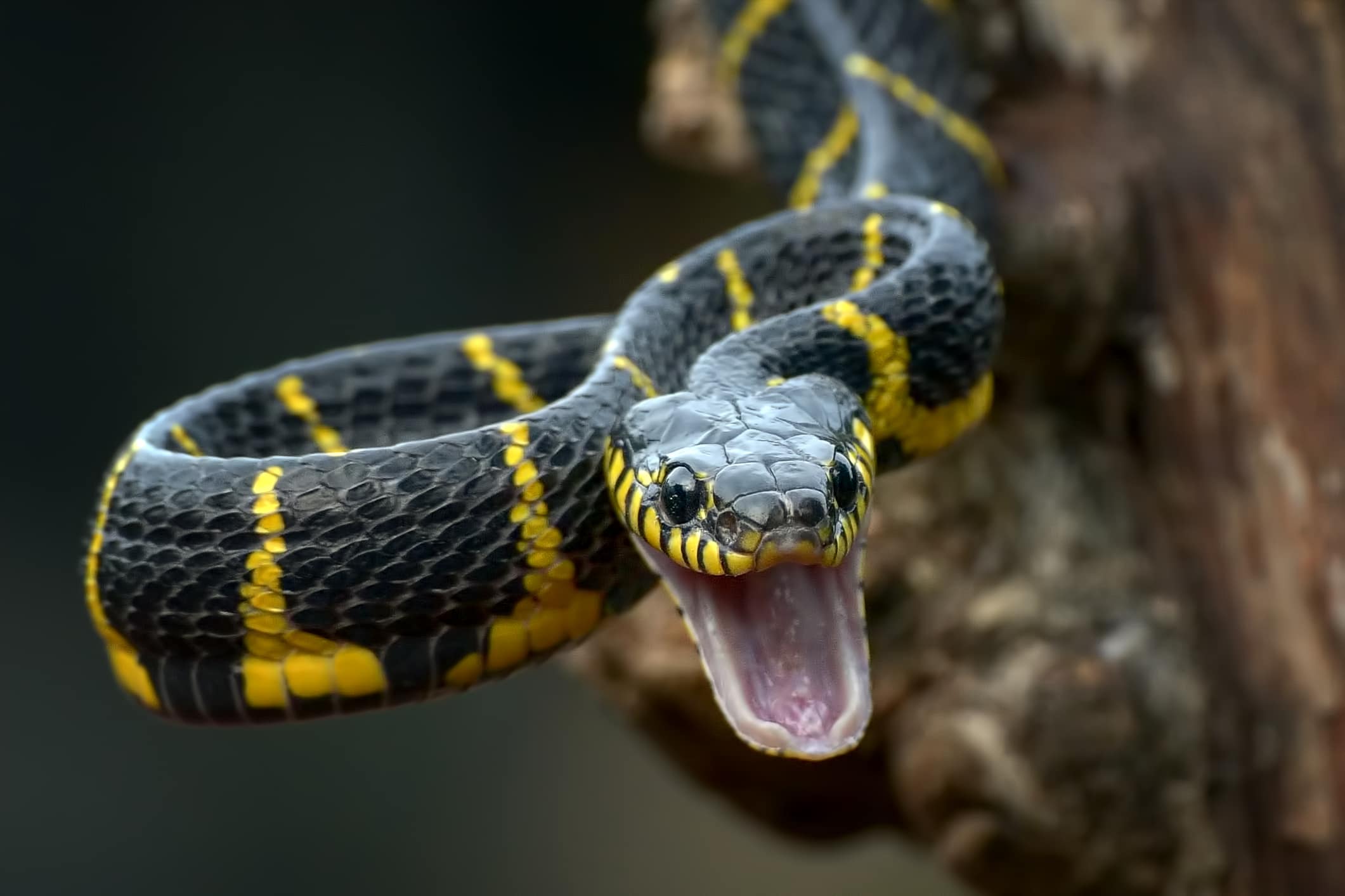
Instantly recognisable by its sleek black body with bright yellow markings, the mangrove snake (Boiga Dendrophilia) is perfectly adapted for hunting in the dense vegetation of Southeast Asia. With venomous fangs and surprising speed and precision, it is undoubtedly one of the aquarium’s most striking predators.
What does a mangrove snake look like?
Growing up to 8 feet long, the mangrove snake is a beautifully patterned snake with a sleek black body wrapped in bright yellow bands. It has big black eyes with narrow vertical slits that help it see in the dark when hunting at night. Its rear fangs are specially adapted to bite and hold onto prey while delivering a venom called denmotoxin. Although its venom packs a punch for the small animals it hunts, it isn’t lethal to humans, just a painful reminder to keep your distance!
Habitat
The mangrove snake is native to the dense mangroves and lowland rainforests of Southeast Asia and can be found across Indonesia, Thailand, Cambodia, and other surrounding regions. The humidity and rich biodiversity make these mangroves the perfect habitat for these snakes. The large branches and tangled roots of the mangroves offer plenty of hiding places for the snakes to avoid predators during the day, and the forest floor is crawling with potential prey for the snakes to hunt at night.
Behaviours
The mangrove snake is a fast and agile predator, well-adapted for hunting in its dense forest environment. It is a solitary species, preferring to live and hunt alone rather than in groups. Primarily nocturnal, it spends the daytime resting among tree branches before descending to the forest floor at night to search for prey. Mangrove snakes are also territorial and will readily defend their space from intruders. However, they are not aggressive towards humans and will usually only strike if they feel threatened.
Diet
The mangrove snake is a carnivore. From birth, young Mangrove Snakes are independent hunters, feeding on smaller prey such as lizards and frogs. Once fully grown, they feed on a larger variety of animals, including birds, frogs, lizards and small mammals. They often hunt in the trees as well as on the forest floor, using their speed and agility to catch prey. Once captured, they use their venom to paralyse prey before swallowing it whole.
Conservation Status
Fortunately, mangrove snakes are not currently listed as endangered. However, their habitats are under increasing threat from deforestation and human development. Losing their habitats would have detrimental impacts on the species in the future.
Find us in Venom
Come and see the mangrove snakes for yourself at Venom, our exhilarating exhibit filled with the most poisonous creatures known to man! This exhibit is the perfect environment to learn about some of the world’s most dangerous creatures, allowing you to get up-close with animals like the mangrove snake, if you are brave enough!
Instantly recognisable by its sleek black body with bright yellow markings, the mangrove snake (Boiga Dendrophilia) is perfectly adapted for hunting in the dense vegetation of Southeast Asia. With venomous fangs and surprising speed and precision, it is undoubtedly one of the aquarium’s most striking predators.

Type
Reptile

What do they eat
Birds, frogs, lizards and small mammals

Size
Up to 8ft long

Water type
Mangroves

Where are we
Southeast Asia
