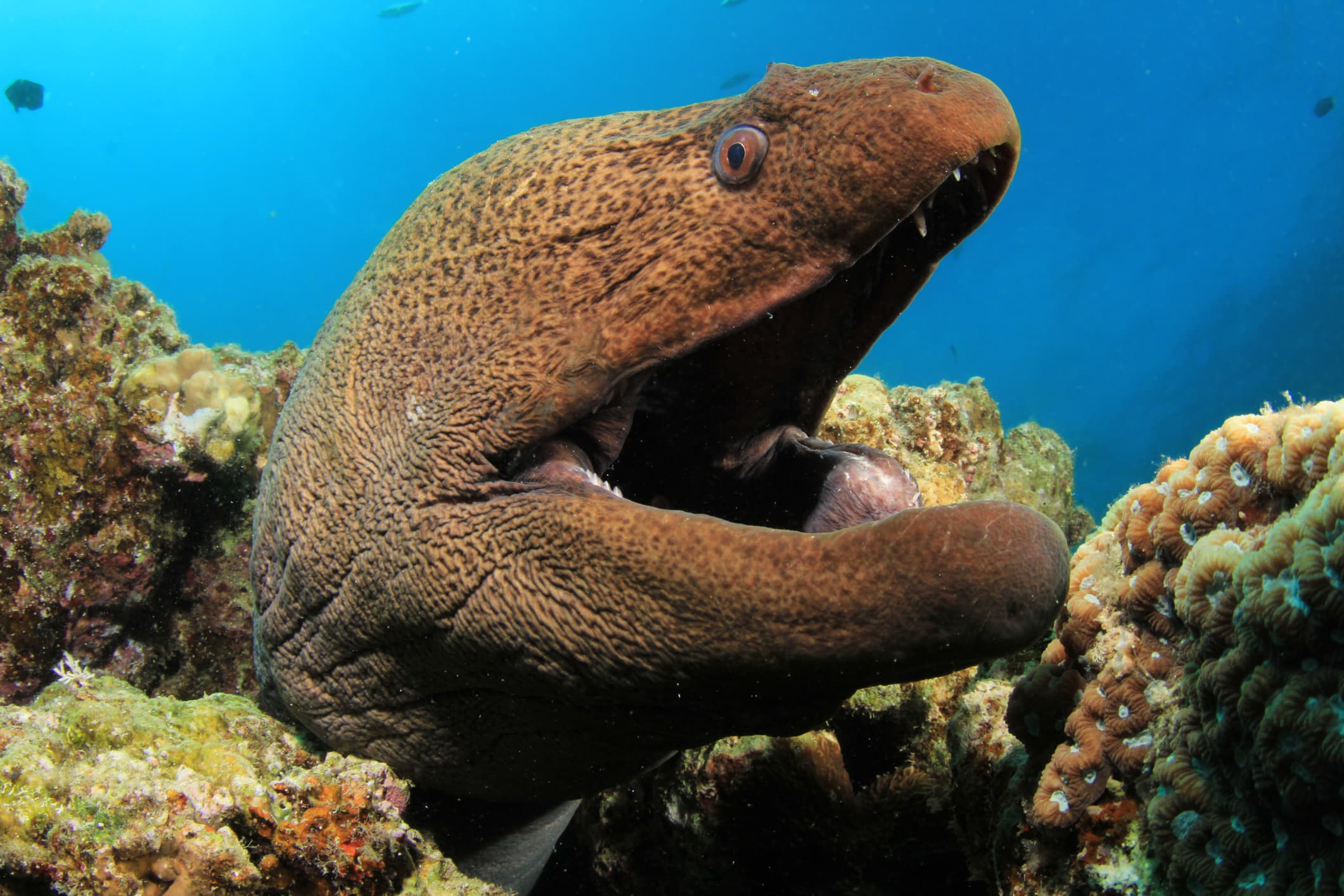
The moray eels may look more like snakes, but they are in fact a fascinating family of fish. Part of the class of ray-finned fish, the Muraenidae family of moray eels are one of around 20 families in the order Anguilliformes. So, now you know a bit of scientific background, we can introduce you to the largest moray eel in the family – the giant moray eel.
Introducing the giant moray eel
The giant moray eel (Gymnothorax javanicus) is the largest of all moray eels. Its closest relatives include other marine moray eels like the honeycomb moray and green moray eels. It’s an ecologically important species and easily recognisable. Let’s find out more about its appearance, habitat and key behaviours.
Appearance and key features
The giant moray eels is the largest moray eel by mass, and has been known to grow up to 3 metres in length and weigh up to 30kg. It has a yellowish-brown body with irregular dark spots all over, and lacks both pectoral and pelvic fins which gives it a snake-like appearance.
It has a thick body that tapers towards the tail, with unblinking eyes, prominent nostrils and a gaping mouth. When you put all of these features together, you have a formidable silhouette that is not easily missed!
Native habitat and range
The giant moray eel is native to the Indo-Pacific region and has a widespread range stretching from the eastern coast of Africa in the Red Sea to Polynesia. The species is typically found across places like Indonesia, Papua New Guinea and parts of Australia.
They prefer warm, tropical waters and primarily live in shallower areas up to 50 metres deep. You may find them in coral reefs and lagoons, and in the day they will favour sheltered rocky crevices. They are thought to occupy the same hiding spot for extended periods of time.
Conservation status
While the giant moray eel is currently listed as Least Concern on the IUCN Red List, it’s still important to consider ways to safeguard this species and its habitat. Preserving their coral reef habitats is key for a number of different species. Other potential threats include bycatch.
Additional facts you should know
There’s so much more to learn about this incredible species, so here’s some extra facts you should know about the giant moray eel.
- They constantly open and close their mouths. While this may look threatening, it’s actually to pump water across its gills which are just behind its head.
- The giant moray eel has incredibly poor eyesight, instead relying on its sense of smell to find food and chemical detection techniques to navigate their environment.
- Giant moray eels are carnivorous apex predators, feeding on reef fish, cephalopods like octopus and squid, and crustaceans. They hunt at night, ambushing their prey.
- Like other moray eels, they have a set of pharyngeal jaws. These are secondary jaws located in the throat, and will shoot forwards to grip and pull prey in.
- They are mostly nocturnal and solitary creatures, but have been known to hunt with other reef predators. An example of this is grouper fish, where groupers will block escape routes while the eel investigates any crevice hiding spots.
- Giant moray eels are also territorial and will defend their habitat where necessary.
- Giant moray eels have a long larval phase after hatching, which can help to maintain genetic diversity and allows the species to colonise new reef systems as they travel vast distances before their juvenile stage.
Where to find us at Blue Planet Aquarium
You can find giant moray eels right here at Blue Planet Aquarium, giving you the chance to put your new knowledge to the test! Our Ocean exhibit is home to giant moray eels, as well as sharks, groupers and other tropical fish.
The moray eels may look more like snakes, but they are in fact a fascinating family of fish. Part of the class of ray-finned fish, the Muraenidae family of moray eels are one of around 20 families in the order Anguilliformes. So, now you know a bit of scientific background, we can introduce you to the largest moray eel in the family – the giant moray eel.

Type
Moray eel

What do we eat
Reef fish, cephalopods like octopus and squid, and crustaceans

Size
Up to 3m in length

Water type
Saltwater

Where are we
Indo-Pacific region

See us at
Ocean exhibit