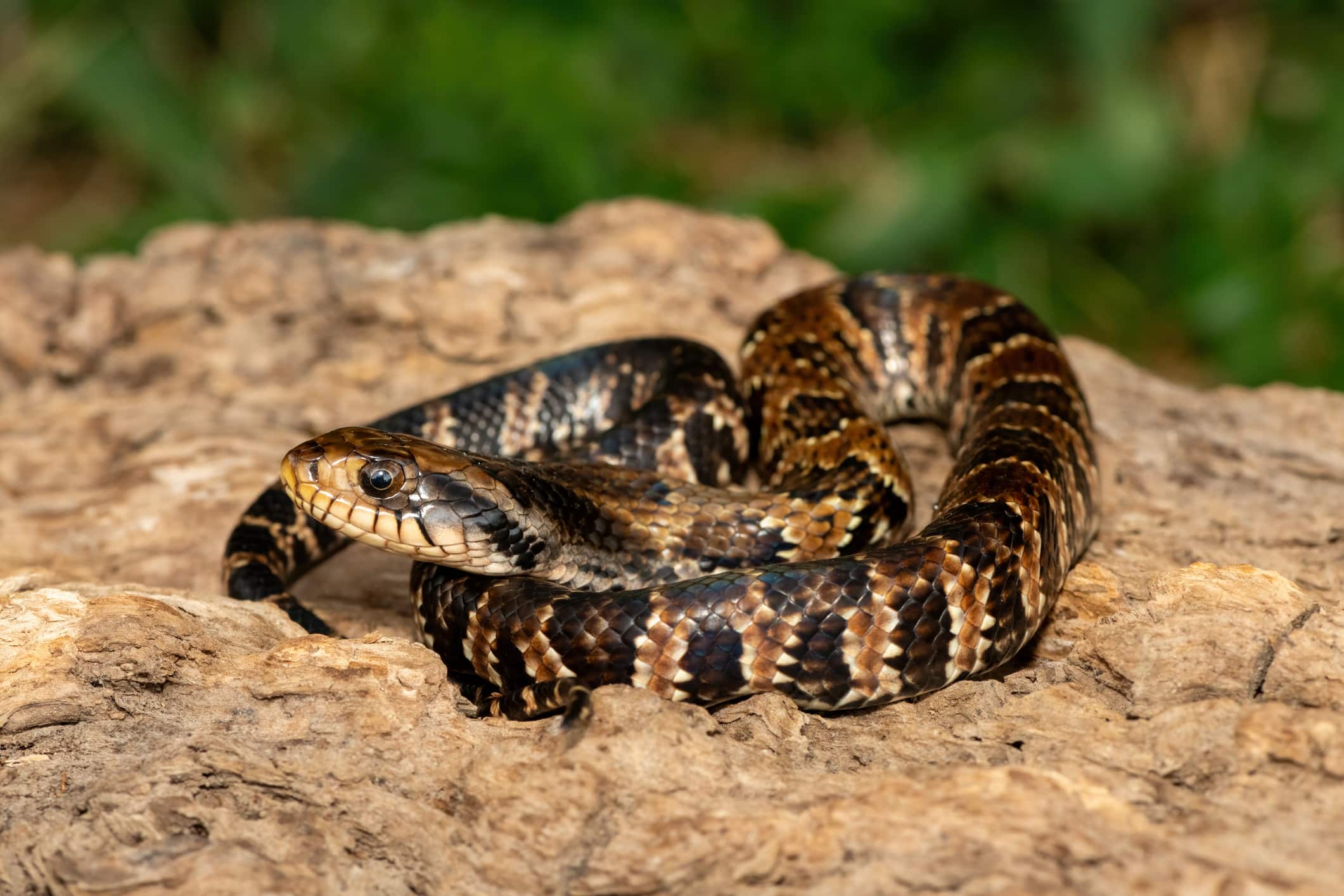
Meet one of the most charismatic and misunderstood residents of the tropical wetlands, a snake that expertly mimics the world’s most famous elapid: the false water cobra.
What is a false water cobra?
The false water cobra (Hydrodynastes gigas) is a large species of Colubrid snake. Unlike the true cobras of Asia and Africa, this reptile belongs to a different family entirely, though it has earned its common name through a remarkable evolutionary trick. When threatened or excited, the false water cobra can flatten its neck into a distinct hood to appear larger and more intimidating to potential predators.
While it is a gifted swimmer and deeply tied to freshwater ecosystems, its cobra title is purely a theatrical defence mechanism rather than a biological classification.
Are false water cobras venomous?
This species occupies a unique middle ground in the world of venomous reptiles. They are technically venomous, but they are classified as rear-fanged, or opisthoglyphous.
Unlike a rattlesnake or a true cobra with fangs at the front of the mouth, the false water cobra’s enlarged teeth are located at the back of the upper jaw. Because of this anatomy, they generally cannot deliver a quick “snap” bite to inject toxins. Instead, they typically need to latch on and employ a chewing motion to effectively channel venom into their prey.
While their venom is highly effective on small amphibians and mammals, it is generally not considered lethal to humans, though a bite can still cause discomfort.
Size and appearance
For visitors wandering through our exhibits, the false water cobra is easy to spot due to its impressive scale, as it stands as one of the largest snakes found in South America.
Mature adults typically display a beautiful palette of olive green or earthy brown, decorated with bold dark spots and bands that wrap around the body. This intricate pattern serves as camouflage, allowing the snake to vanish against the dappled light of a rainforest floor.
If you look closely at their underside, you will see ventral scales in shades of yellow or brown, marked by dotted lines merging toward the tail. Interestingly, young false water cobras look quite different from their parents, sporting much darker colouration and lacking the characteristic large eyes seen in adults.
False water cobra’s native habitat
These neotropical snakes are native to the lush landscapes of southern Brazil, eastern Bolivia, Paraguay, and northern Argentina. They are highly versatile animals, comfortably splitting their time between land and water. You will almost always find them in humid, wet environments, particularly near slow-moving streams, marshes, or within the vast floodplains of South American rivers. Their lifestyle is dictated by the water’s edge, where the humidity keeps their skin healthy, and there is plenty of food for them to hunt.
False water cobra conservation status
Currently, the false water cobra is listed as Least Concern by the IUCN, with populations remaining relatively stable across their native range. However, they are not entirely without risk. Like many South American species, they face ongoing threats from habitat destruction as wetlands are drained for agriculture. Additionally, their striking appearance and active personalities make them targets for the illegal pet trade, which can put pressure on localised wild populations.
5 additional facts about false water cobras
Before your visit to see the false water cobra, stock up on some fun facts about these fascinating animals.
False water cobras are carnivores
False water cobras are dedicated carnivores with a varied diet consisting of fish, frogs, tadpoles, and other aquatic amphibians, though they will also hunt small mammals and birds.
Unusual hunting methods
A false water cobra will catch their prey and use their body to partially coil around it, sometimes consuming it while still alive.
Large litters
Reproduction is a major event for this species, as a single female can produce an impressive clutch of up to 40 eggs.
Independence starts early
As hatchlings emerge fully equipped to hunt and survive without any parental care, they are incredibly independent even from birth.
Active during the day
They are primarily diurnal, which means active in the day, but often described more as crepuscular and are actually most active at dawn and dusk, making them much easier for visitors to observe than their nocturnal cousins.
Find us in Venom
If you are ready to see the impressive hooding display of the false water cobra for yourself, make sure to visit our Venom exhibit. This zone is dedicated to the most fascinating and venomous animals of the natural world.
Meet one of the most charismatic and misunderstood residents of the tropical wetlands, a snake that expertly mimics the world’s most famous elapid: the false water cobra.

Type
Reptile

What do they eat?
Fish, frogs, tadpoles and other aquatic amphibians, as well as small mammals and birds.

Size
Around 6-7ft on average

Water type
Freshwater

Where are we?
South America
