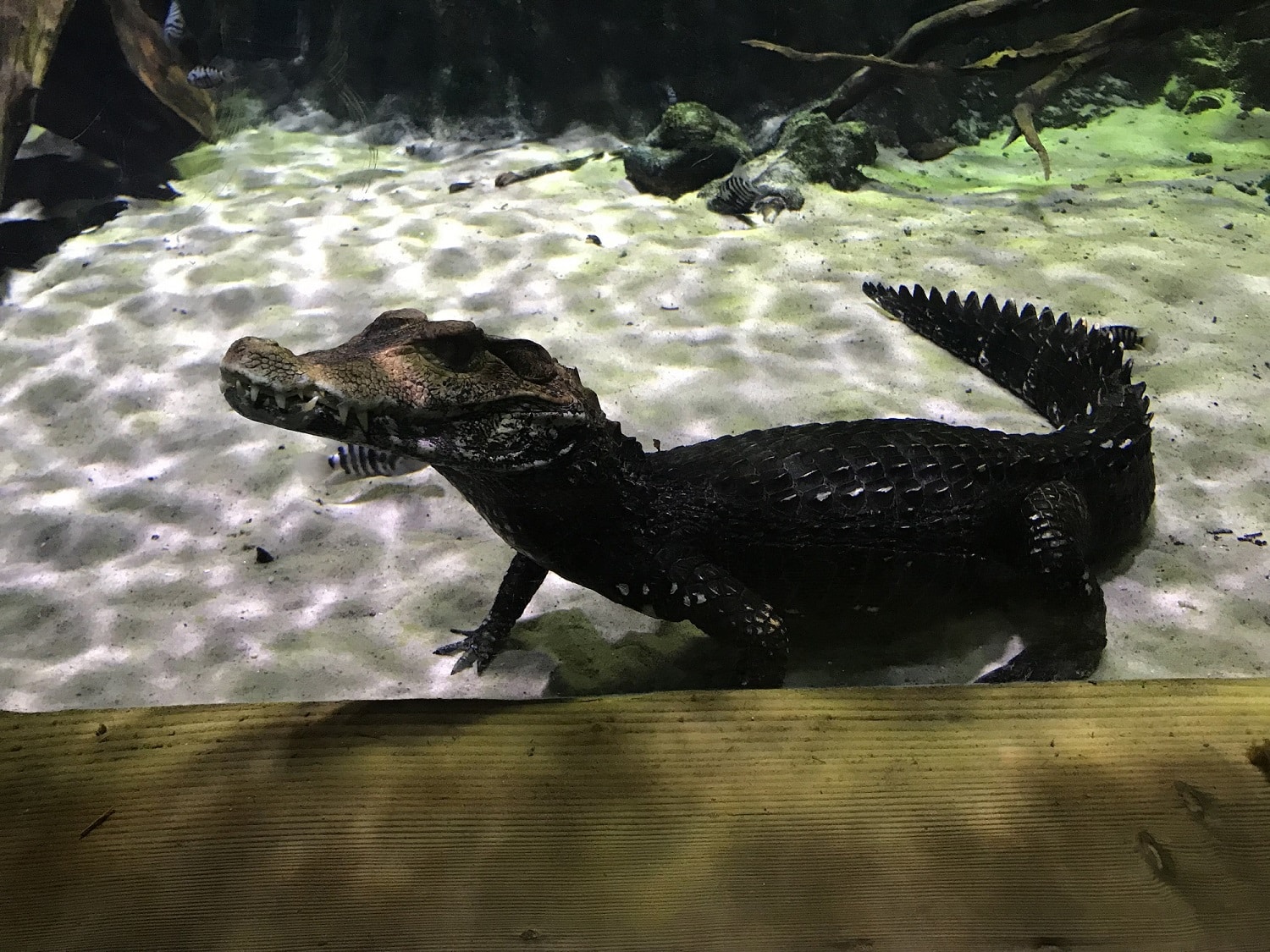
The Cuvier’s dwarf caiman (Paleosuchus palpebrosus) is a fascinating reptile, and although it is small, it is certainly not a species to be underestimated! Also sometimes known as the musky caiman, its scientific name translates to ‘ancient crocodile with full eyelids’. So, whether you’re already familiar with this type of animal or it’s completely new to you, let’s learn all about its habitat, diet and other fun facts!
Native Habitat
The Cuvier’s dwarf caiman is native to the rivers and streams of northern and central South America, found in countries such as Bolivia, Brazil, Colombia, Paraguay and Venezuela. It is a freshwater species, preferring the slow-moving waters and lots of vegetation. They will also sunbathe amongst marshes and swamps to help regulate their body temperature.
Diet
The dwarf caiman has sharp, backward-curved teeth which helps them to eat the likes of invertebrates and crustaceans, although they will also feed on fish and amphibians. They have a specialised area of their stomach called a gizzard, which acts as a grinding mechanism to break down food. It contains stones that the caiman purposely swallows to help with this. They hunt at night, sneaking up on their prey.
Appearance
The Cuvier’s dwarf caiman is the world’s smallest crocodilian, growing to around 1.2-1.4 metres. The maximum length is typically around 1.5 metres, although there have been cases of the caiman growing to over 2 metres in the Brazilian wetlands. They are typically dark brown-black in colour, with a reddish-brown head. Juveniles are usually lighter in colour. These caimans also have strong body armour to protect against larger predators, like boa constrictors and jaguars.
Conservation Status
This particular species was last assessed by the IUCN in 2018 where it was classified as Least Concern, with a stable population. However, threats to the species include pollution and habitat destruction, which could quickly change the status of the dwarf caiman if conservation efforts aren’t continued, particularly when it comes to the Amazon.
Discover more – 6 fun facts about the dwarf caiman
- The Cuvier’s dwarf caiman was first discovered in 1807 by French zoologist Georges Cuvier, hence the name. It was Georges Cuvier who established the fact of extinction, and he also created the scientific study of fossilised animals with backbones, now known as vertebrate paleontology.
- A caiman is neither a crocodile nor alligator, but its own species. It is part of the Alligatoridae family but then the subfamily Caimaninae, along with 5 other recognised species of caimans. This includes 3 different genera; Caiman, Melanosuchus and Paleosuchus.
- What’s more, this particular caiman is known as a New World crocodilian as it is from the Americas, while the Old World species are usually from Africa. They are distinguished by a more slender snout than its Old World counterparts.
- Cuvier’s dwarf caimans can live for around 25 years, which is thanks to their heavily armoured skin.
- This species is thought to be one of the most terrestrial of all crocodilian species, which means they are well-adapted to living on land as well as water. They frequently travel across land at night. They can also tolerate much cooler water than other species.
- The eggs of a dwarf caiman incubate for around 90 days until they hatch. The temperature at incubation determines the gender of the hatchlings, with lower temperatures typically resulting in females.
So, there you have it! Everything you need to know about this small but mighty species. You can come and see a Cuvier’s dwarf caiman with your own eyes right here at Blue Planet Aquarium, in our Caiman exhibit! Don’t forget to book your tickets for your next visit.
The Cuvier’s dwarf caiman (Paleosuchus palpebrosus) is a fascinating reptile, and although it is small, it is certainly not a species to be underestimated! Also sometimes known as the musky caiman, its scientific name translates to ‘ancient crocodile with full eyelids’. So, whether you’re already familiar with this type of animal or it’s completely new to you, let’s learn all about its habitat, diet and other fun facts!

Type
Reptile

What do they eat
Fish, frogs and small mammals

Size
1.5m

Water type
Fresh water

Where are we
South America
