Learn All About Sturgeon Fish
One of the world’s oldest fish species, the sturgeon’s ancestors appeared around 200 million years ago, while the true sturgeon of today appeared as long ago as 100-66 million years ago.
Despite being found across most of the Northern Hemisphere in large river systems, estuaries, and coastal waters in North America, Europe, and Asia, some species are critically endangered while others are classified as endangered or vulnerable.
In this blog, we’re going to dive into everything about sturgeons: their habitat, their appearance, fun facts and more.
What are sturgeon fish?
Sturgeons (Acipenseridae) are a family of fish comprising 27 species, with fossils dating back to the late Cretaceous period.
Some species of sturgeon can be absolutely enormous, like the largest freshwater fish in the world, the beluga sturgeon (Huso huso). The smallest species of sturgeon, on the other hand, the dwarf sturgeon (Pseudoscaphirhynchus hermanni), is only around 27cm long and only weighs about half a kilo.
They are typically found in high-oxygen, cold waters of the northern hemisphere, with a limiting factor of their distribution being mostly down to temperature.
What do sturgeon fish look like?
Sturgeon fish are fascinating animals which give us a look into what the waters of the world might have looked like millions of years ago.
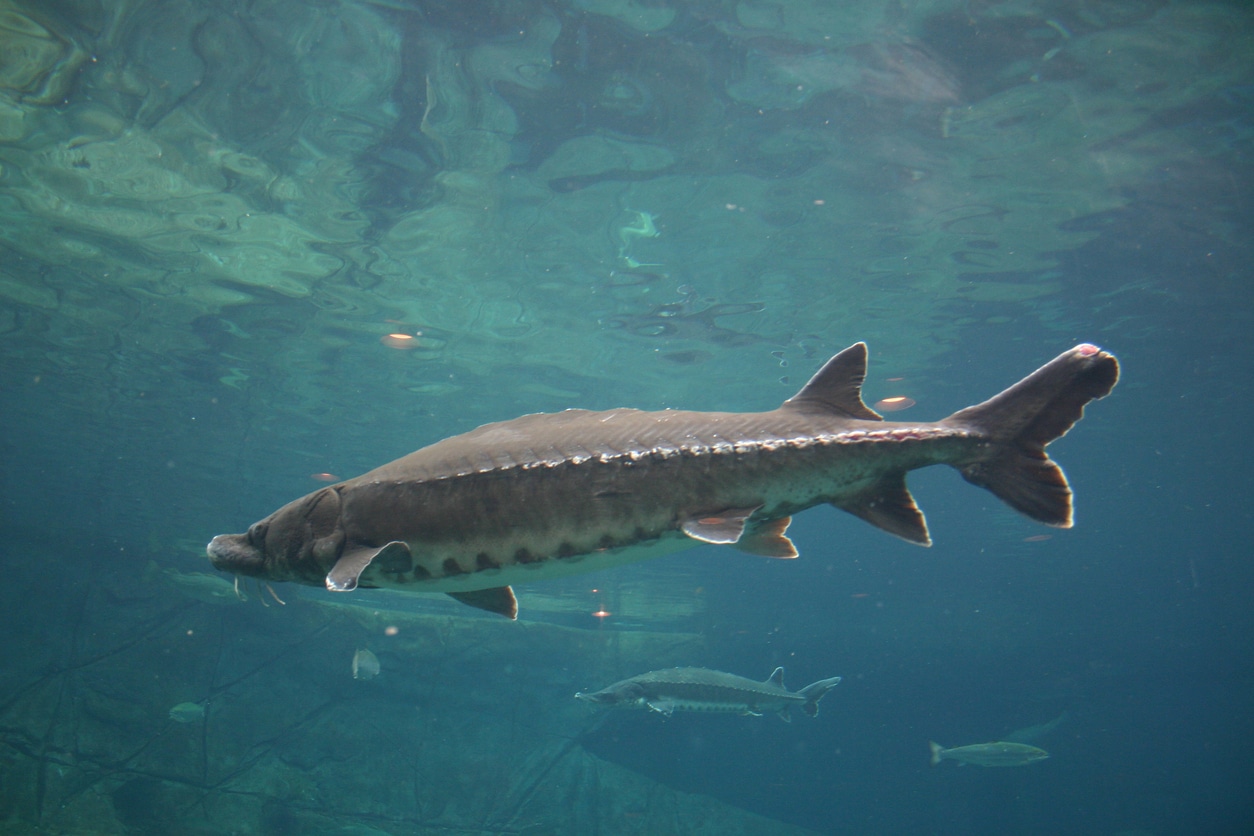
At a glance, they look a bit like sharks, but they’re not actually related to sharks.
They have bony plates called scutes covering their head, and five rows of scutes run along their bodies, primarily acting as protection from predators.
Like catfish, sturgeons have barbels, which are whisker-like, fleshy, sensory organs located on the underside of their snout, in front of their mouth. Inside their mouth, you will not find any teeth. Instead, they use their mouth as a vacuum to feed on the bottom of river beds and estuaries.

How big do sturgeon fish get?
As we mentioned, sturgeons can get pretty big. The largest, the beluga sturgeon, is the largest freshwater fish in the world, weighing up to 1,500 kg and reaching a length of up to 24 feet (around 7 metres). To sustain this huge size, they eat other fish, including gobies and herring, as well as crustaceans and molluscs.
While some species remain relatively modest in size, others—like the record-breaking Beluga—can grow to staggering lengths of 7 to 12 feet or more.
Interesting facts about sturgeon fish
Sturgeons are some of the most mysterious and ancient residents of our waters. Often described as living fossils, these armoured creatures have a history that stretches back to the age of the dinosaurs.
They have been around for over 200 million years
Sturgeons are true survivors, having outlasted the dinosaurs by millions of years. Their appearance has changed very little since then, meaning when you look at one, you are essentially peering back through time!
There are over 20 species of sturgeon fish
While they all share a similar “armoured” look, sturgeons come in all shapes and sizes. Did you know that the UK has its own native species? The European sturgeon is the only truly native species, while others are from across the world, such as the Atlantic sturgeon which is native to North America.

Sturgeons thrive in freshwater rivers and lakes
Some species of sturgeon are famous for spending the majority of their lives in sea water, only coming into freshwater for spawning. They can often be found in slow-moving currents of large river systems, like the Danube River.
They are bottom-dwelling feeders
You won’t often find a sturgeon leaping out of the water; they prefer to stay close to the riverbed. They use their sensitive whiskers, called barbels, to feel the bed of the water and locate food like small fish, crustaceans, and snails.
However, there are some species of sturgeon, renowned for their ability to leap out of the water to adjust their buoyancy or communicate, like the Gulf sturgeon or the Atlantic sturgeon.
Are sturgeon fish endangered?
Unfortunately, sturgeon are considered critically endangered. For centuries, sturgeons have faced heavy depopulation to harvest their eggs as caviar. In more recent times, things like climate change and pollution have led to a significant habitat loss.
Conservation efforts of their habitat are ongoing, as well as more humane ways of harvesting caviar to preserve populations. With worldwide efforts, sturgeons will still be around for generations to come!
Learn more about sturgeon fish at Blue Planet Aquarium
At Blue Planet Aquarium, we’re lucky enough to have Siberian sturgeon swimming through our Northern Streams exhibit, as well as Russian sturgeon (Huso gueldenstaedtii). They’re large fish, growing up to 2 metres in length, and are usually found swimming through the large, northward-flowing river basins of Siberia.
Like other sturgeons, they strongly resemble sharks with a large rear fin along a grey body. However, their dorsal fin is significantly further back than a shark’s, giving it great stability for feeding on riverbeds.
If you’re excited to see this prehistoric animal, there’s no better place than right here. Blue Planet Aquarium is a great place for a family day out or a school trip, there’s always plenty to learn and admire.
Talks and feeds are available to watch throughout the day, giving you the opportunity to ask our team of experts any questions you have about the animals, their environment, or what they eat.
Book your tickets now, and get ready to step back in time with sturgeon!


