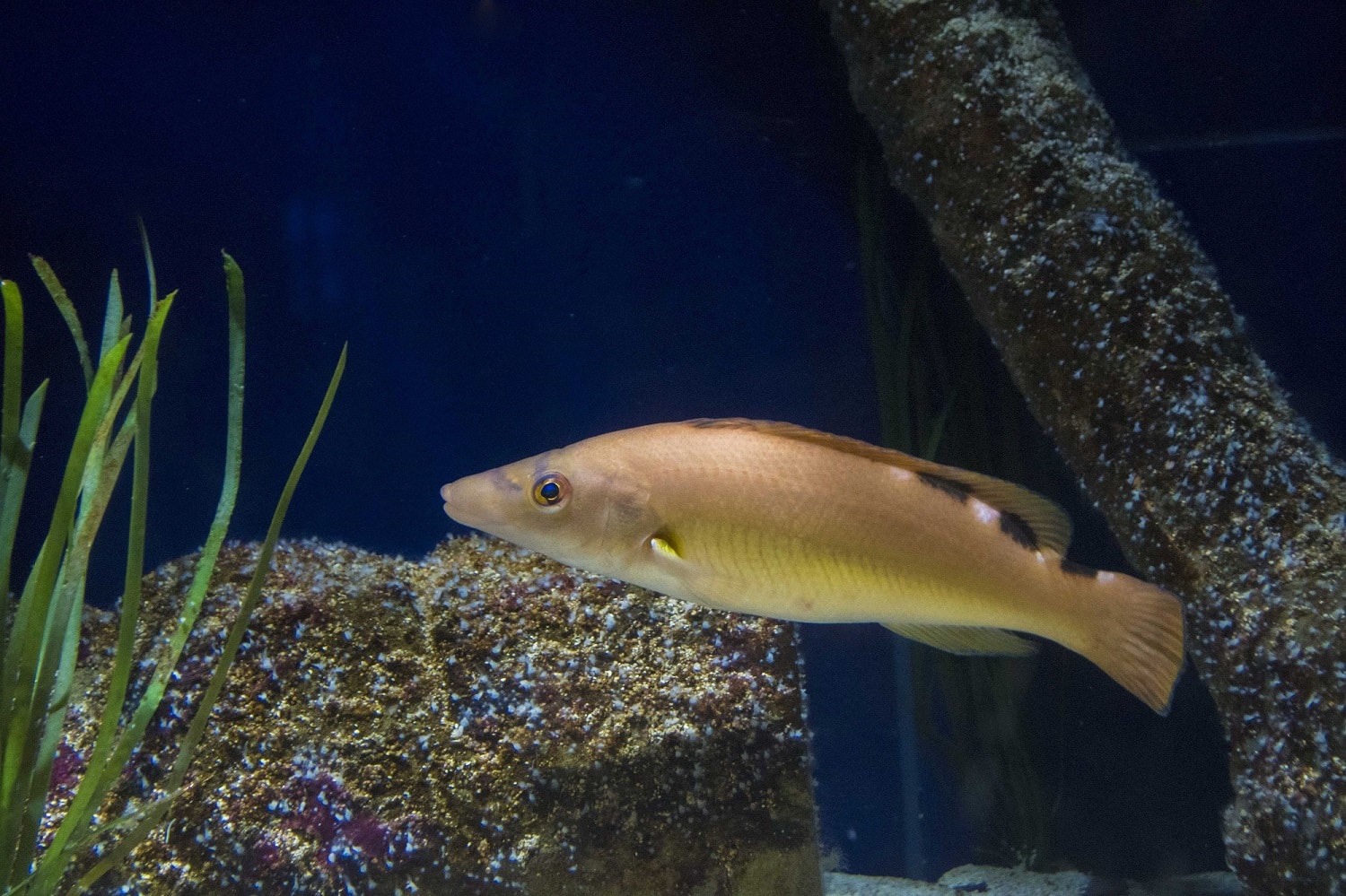
How Many Types of Fish are There? Fish Classification Explored
Across the world’s oceans, there are an incredible number of fish species that come in all different shape and sizes. From ginormous whale sharks (Rhincodon typus) to Photocorynus spiniceps, there is fantastic variation, which is why ocean exploration is so important to scientists who want to understand life on Earth.
In this blog, we’re going to cover the absolute basics of fish classification to start you on your journey of marine discovery, which should definitely be followed up by a trip to Blue Planet Aquarium.
How many types of fish are there?
As we mentioned, the ocean is teeming with marine life, and scientists are still unsure just how many types of fish there are, but current estimates place it at around 36,500 individually recognised fish species.
To put this number into perspective, the number of fish species is more than all amphibian, reptile, bird, and mammal species combined!
The vast number of species of fish shows just how adaptable fish have been over their 530 million-year history on Earth. They first appeared during the Cambrian period, making them much older than dinosaurs, mammals and even trees.
Over this time, fish such as the megalodon (Otodus megalodon), Chinese Paddlefish (Psephurus gladius), and, more recently, the Thicktail Chub (Gila crassicauda) have gone extinct, but the vast majority have endured.

Of those species, they are split into two main categories…
Cartilaginous fish
It might sound odd to split fish into cartilaginous and bony fish, but you might be surprised to learn that some fish don’t actually have any bones. While it’s only about 4% of fish, it’s fish you likely will have heard of.
Cartilaginous fish characteristics
The key thing that separates cartilaginous fish (Chondrichthyes) from bony fish is their lack of bones. Instead, their skeleton is made of cartilage – the same stuff that makes up our ears and nose. This adaptation allows them to be lighter and more flexible, a crucial difference for predators like Great White Sharks (Carcharodon carcharias) who need to make sharp, quick turns to catch prey.
Examples of cartilaginous fish
Sharks and rays, for example, have a skeleton made of cartilage. For this reason, shark skeletons are extremely rare to find, unless they’re preserved in the right conditions. Unlike bones, cartilage breaks down very quickly, leaving only teeth behind. The lower density of cartilage compared to bone is one of the reasons that cartilaginous fish like whale sharks (Rhincodon typus) can grow so large.

Bony fish
Bony fish (Osteichthyes) make up about 96% of fish, or over 34,000 species of fish. They’re found all over the world, in rivers, lakes, seas and oceans, much like cartilaginous fish. The largest bony fish in the world is the giant sunfish (Mola alexandrini), which can weigh up to an enormous 2,744 kg, or the weight of two Volkswagen Golfs.
Bony fish characteristics
The two primary benefits of fish that have bones instead of a cartilaginous skeleton; firstly, it allows muscles to anchor strongly to the bone, for more explosive power for faster acceleration through the water. It also gives them better manoeuvrability than animals like sharks. Fish with bones can execute highly precise movements, stop abruptly, and hover or swim backwards, whereas cartilaginous fish primarily move like aeroplanes.
Examples of bony fish
Bony fish are incredibly abundant across the globe, including common fish such as the European sea bass (Dicentrarchus labrax), Atlantic salmon (Salmo salar), and Atlantic bluefin tuna (Thunnus thynnus). Experts suggest that bony fish were more able to deal with mass extinction events and gradually changing environments, which explains why there are so many species of bony fish.

Jawless fish
Older than any other type of fish, jawless fish are a subset of cartilaginous fish. They’re so old that they evolved before jaws were adapted by modern fish. Today, there are only 120 species of jawless fish still on Earth, compared to the tens of thousands that scientists estimate there used to be.
Jawless fish characteristics
As jawless fish are a subset of cartilaginous fish, they share many of the same characteristics, except that they have no jaw. This key difference means that they have to use their round, open mouths like a vacuum to suck up food. They also do not have side fins, as other types of fish do.
Interestingly, they have a notochord instead of a backbone. Humans also have a notochord, but it begins to degenerate in the womb and is usually completely gone by the age of four.
Examples of jawless fish
Jawless fish, like the sixgill hagfish (Eptatretus hexatrema) and the Pacific lamprey (Entosphenus tridentatus) have an eel-like appearance to them, but crucially, they are not eels; eels are bony fish.
Jawless fish do not grow as large as other types of fish like they did in prehistoric times. Today, the largest one, the goliath hagfish (Eptatretus goliath) only grows to about 127.5cm.

How many types of fish can you spot at Blue Planet Aquarium?
At Blue Planet Aquarium, we house hundreds of fish and other marine animals. We perfectly replicate the conditions of their natural habitat to make the animals feel right at home.
You can even step into the home of the animals during a shark dive at Blue Planet Aquarium, allowing you to get up close with bony and cartilaginous fish.
Or, if you’d rather stay dry, you can see the animals in our 71-metre tunnel that goes right through our Ocean Exhibit! Book your tickets today to open up a world of underwater adventures!


